



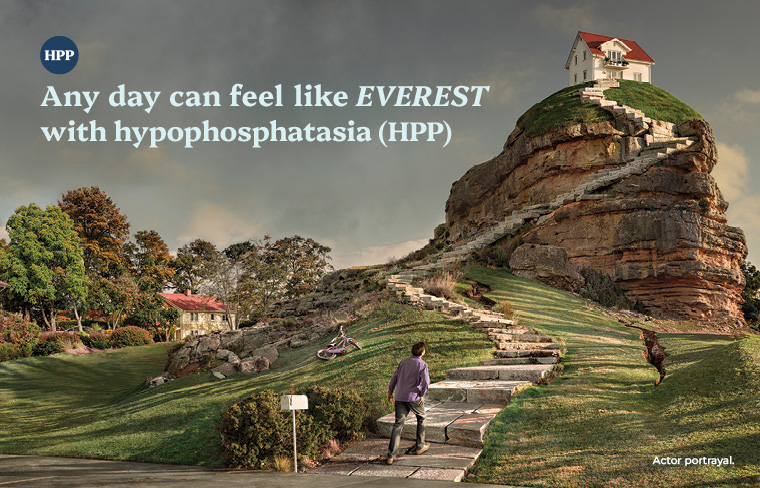
HPP is an inherited, multisystemic metabolic disease that can progress, and is caused by deficient alkaline phosphatase (ALP) activity in adults and children.1-3 ALP deficiency may lead to impaired bone mineralization and skeletal complications, including fractures, and functional impairments, including muscle weakness, fatigue, and pain, as well as neurological complications.4-11 These manifestations may affect patients’ quality of life and daily activities, including their ability to work, connect, and live independently.9,12-14
In adults, HPP can resemble other conditions like osteoporosis, arthritis, and fibromyalgia, which is an important reason why adults may face an average 10-year delay before receiving an accurate diagnosis.1,15-20 To diagnose HPP, look for persistently low age- and sex-adjusted ALP* alongside clinical signs and symptoms such as impaired physical function, musculoskeletal and joint pain, bone fractures, or chronic fatigue.1,3,4,14,20-27
Continue the conversation
Visit the Alexion AstraZeneca Rare Disease Booth #3221 to learn more about recognizing the clinical manifestations of HPP and identifying signs and symptoms that can lead to an accurate diagnosis.
Unable to attend? Click the link below to contact an Alexion Representative for more information.
*Persistently low ALP can be defined as 2 or more ALP levels below the normal range adjusted for age and sex in intervals of more than 30 days. Other causes of low ALP should be ruled out prior to establishing an HPP diagnosis.20,21,22,28
References: 1. Injean P, et al. ACR Open Rheumatol. 2023;5(10):524-528. 2. Villa-Suárez JM, et al. Int J Mol Sci. 2021;22(9):4303. 3. Conti F, et al. Clin Cases Miner Bone Metab. 2017;14(2):230-234. 4. Rockman-Greenberg C. Pediatr Endocrinol Rev. 2013;10(suppl 2):380-388. 5. Hessle L, et al. Proc Natl Acad Sci USA. 2002;99(14):9445-9449. 6. Cheng X, Zhao C. Medicine (Baltimore). 2023;102(32):e34755. 7. Salles JP. Clin Biochem Rev. 2020;41(1):13-27. 8. Kim SM, et al. Osteoporos Sarcopenia. 2023;9(4):115-120. 9. Dahir KM, et al. Orphanet J Rare Dis. 2022;17(1):277. 10. Högler W, et al. Endocr Connect. 2023;12(5):e220240. 11. Andreo-López MC, et al. Int J Mol Sci. 2025;26(13):6153. 12. Hӧgler W, et al. BMC Musculoskelet Disord. 2019;20(1):80. 13. Weber TJ, et al. Metabolism. 2016;65(10):1522-1530. 14. Pierpont EI, et al. Orphanet J Rare Dis. 2021;16(1):80. 15. Szabo SM, et al. Orphanet J Rare Dis. 2019;14(1):85. 16. Tsang T, Raghuwanshi MP. J Endocr Soc. 2021;5(suppl 1):A201-A202. 17. Yoshida H, et al. Endocrinol Diabetes Metab Case Rep. 2025;2025(1):e240121. 18. Feurstein J, et al. Orphanet J Rare Dis. 2022;17(1):435. 19. Bangura A, et al. Cureus. 2020;12(6):e8594. 20. Brandi ML, et al. Osteoporos Int. 2024;35(3):439-449. 21. Rush E, et al. Osteoporos Int. 2024;35(1):1-10. 22. Khan AA, et al. Osteoporos Int. 2024;35(3):431-438. 23. Durrough C, et al. Bone. 2021;142:115695. 24. Lefever E, et al. J Clin Densitom. 2020;23(3):340-348. 25. Bishop N, et al. Arch Dis Child. 2016;101(6):514-515. 26. Hoff P, et al. BMJ Open. 2025;15(7):e097235. 27. Larsen PB, et al. Pract Lab Med. 2018;11:19-22. 28. Vieira LHR, et al. Arch Endocrinol Metab. 2021;65(3):289-294.
US/UNB-H/1031 V1 10/2026