


Most 21st century researchers and clinicians have relied largely on models of rheumatoid arthritis (RA) from the last century. Most people think of RA as a Th1 or Th2 disease based on discoveries of T helper cells producing interferon gamma (INFγ) to trigger inflammation and Th17 cells seen in mouse models of RA.
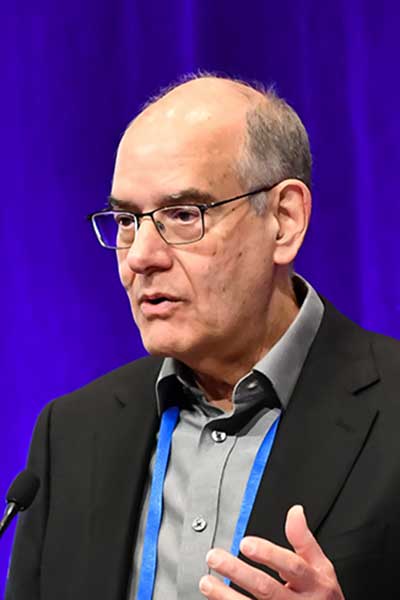
“Both of these ideas are substantially inaccurate, not 100% off, but not really right for rheumatoid arthritis,” said Michael Brenner, MD, the E.F. Brigham Professor of Medicine at Harvard Medical School and Director of the Human Immunology Center and the Single Cell Genomics Core at Brigham and Women’s Hospital.
“Something we started doing more than a decade ago is to take a different approach, an unbiased approach,” he explained on Monday afternoon at ACR Convergence. “Basically, look at high-dimensional data in the tissue of rheumatic arthritis. Ignore what’s done in the literature and just ask what’s there, what jumps out at you, what’s striking, and then figure out what that might be and what it turns out to be.”
Dr. Brenner recounted the results of that approach during the Paul Klemperer Memorial Lecture, “New Paradigms in the Immunopathogenesis of Rheumatoid Arthritis and Other Autoimmune Diseases.” Recorded sessions at ACR Convergence 2025, including Memorial Lectures, will be available on demand to all registered meeting participants within 72 hours of the live presentation through October 31, 2026, by logging into the meeting website.
One of the first findings was a surprising number of CD4 and CD8 cells in RA knee synovial fluid.
Neither cell type was as expected, Dr. Brenner explained. Both were abundant. CD4 T cells accounted for about 30% of the cells in synovial fluid and CD8 T cells nearly 60% by flow cytometry.
CD4 is most often associated with T follicular helper (Tfh) cells, which drive B cell differentiation. These CD4 cells were clearly distinct from Tfh cells, but they performed a similar task, generating cytokines that help B cells in the periphery, earning the name T peripheral helper cells (Tph).
Tfh cells drive germinal center reactions, Dr. Brenner said. Tph cells trigger local antibody production to drive extrafollicular B cell differentiation.
The CD8 T cells in synovial fluid were not exhausted, they were actively producing more IFNγ than CD4 T cells. And while most CD8 cells are memory and effector cells, CD8 cells in RA synovial fluid were largely killer cells, dominated by expression of granzyme K (GzmK).
GzmK binds directly to the cell surface to activate the terminal complement pathway and the entire complement cascade. GzmK T cell expansion is seen in multiple autoimmune neurologic and allergic diseases, aging, and cancers.
GzmK also activates inflammation and tissue destruction in the synovium mediated by fibroblasts.
Fibroblasts are activated by a variety of cytokines to produce both inflammatory cytokines and chemokines and erosive/destructive proteins. The sublining fibroblast population expands about 20-fold in RA, primarily around blood vessels. Fibroblast expansion and arthritis are driven by Notch3 signaling and Wnt signaling, with Wnt signaling playing a dominant role.
Synovial fibroblasts also upregulate AT-rich interactive domain (ARID) 5B, a risk allele seen in multiple diseases, that can both demethylate and deacetylate multiple loci to promote inflammation and tissue invasion/degradation, depending on the promoters it binds. These pathways are seen in RA, Dr. Brenner noted, but have not been identified in osteoarthritis.
In RA, ARID 5B acts as a switch to reduce inflammation and drive invasion, then erosion and destruction, of cartilage and bone, at least in rodent models of RA. Both ARID 5B pathways appear to be part of a cascade modulated at least in part by a global regulator, transcription factor ETV7.
ETV7 remains something of a mystery, Dr. Brenner said, but appears to globally downregulate fibroblast activation signatures. The literature describes ETV7 as a transcriptional repressor, and it is a known risk allele in RA and other diseases.
“There may be ETV7 pathways, and others, that can be targeted,” he said.
JOIN US IN ORLANDO
If you haven’t registered for ACR Convergence 2026, register today to participate in this year’s premier rheumatology experience, November 6–11 in Orlando, Florida. All registered participants receive on-demand access to scientific sessions after the meeting through September 30, 2027.