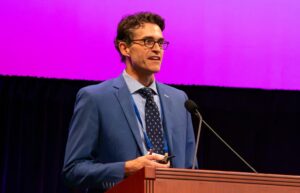
During the Medical Education Year in Review at ACR Convergence 2026, Miriah Gillispie-Taylor, MD, summarized 21 papers spanning five themes, including artificial intelligence (AI), providing feedback, and other trending topics related to training the next generation of professionals.

Gillispie-Taylor, MD
A recording of the session will be available to registered participants of ACR Convergence 2026 for on-demand viewing.
Teaching Critical Reasoning and Providing Useful Feedback
“Giving good feedback is an art. So how do we tell residents or medical students what they’re doing well, how they can improve, and do it in a way that’s very specific and meaningful?” said Dr. Gillispie-Taylor, Assistant Professor at Baylor College of Medicine and Pediatric Rheumatologist at Texas Children’s Hospital.
She cited a study that assessed which clinical reasoning tasks residents address when presenting ambulatory cases and how these relate to expertise. One key finding was that the number of tasks was not important.
“Just checking the boxes on this list was not what mattered,” Dr. Gillispie-Taylor said. “It was knowing which tasks were important for which patient.”
Another paper explored whether the timing of entrustable professional activity (EPA) completion changes how residents experience EPA feedback. It found that a “sweet spot” appears to be early, but not immediate, and that feedback given later was likely to be less engaging.
Teaching and Assessing Clinical Skills
One of the papers Dr. Gillispie-Taylor mentioned related to teaching and assessing clinical skills for rheumatology explored whether learner confidence reflects competence following ultrasound training. The findings revealed that learner self-ratings agreed with each other. Those who felt more knowledgeable also felt more confident in scanning, and those who felt more confident in scanning also felt ready to scan at work.
However, these self-ratings did not predict actual performance, Dr. Gillispie-Taylor noted. Thus, confidence, perceived knowledge, and perceived readiness were not associated with written or practical scores. High and low performers were equally confident.
“It means that you have to sort of work to find the confident person who is not quite competent yet, because that’s the person who is going to need the most feedback,” Dr. Gillispie-Taylor said.
Rethinking Fellowship Curricula, Assessment, and CBME
When exploring the potential for changing fellowship curricula, assessment, and competency-based medical education (CBME), Dr. Gillispie-Taylor said it was necessary to take a step back from individual skills to examine the broader picture. One of the papers she discussed addressed how the educational environment affects training. The authors said while the clinical learning environment functions as the delivery engine for CBME, it only works when learners feel safe enough to be vulnerable, are observed, and have time to reflect.
Members of the International Competency-Based Health Professions Education Collaborative developed a framework for implementing CBME in the clinical space that centered around five priorities: psychological safety, a strong teaching environment, productive struggle, interdependence, and aligning health systems with education.
Extending the Reach of Rheumatology Education
Dr. Gillispie-Taylor discussed multiple papers on enhancing access and equity to rheumatology, as well as emerging approaches to bolstering education. One addressed the impact of a rheumatoid arthritis (RA) training program for primary care specialists in the Navajo Nation. This population has one of the highest incidences of RA burden, with limited access to specialists and many patients having to travel more than 100 miles to see a rheumatologist.
As a result of the RA program, knowledge among trainees rose from 46% to 71%, and knowledge retention was 69% one year later.
“It worked because the authors and the team met the community where they are, met the patients where the need really was,” Dr. Gillispie-Taylor said. “The program was built from a real needs assessment that centered most on what mattered to the people that it served.”
Dr. Gillispie-Taylor also highlighted two papers on emerging approaches for rheumatology education. One focused on a card game for medical students to help reinforce skills and spark a potential interest in rheumatology. Another gamification model for internal medicine residents was built off the popular Snakes and Ladders game.
Emerging Approaches in Rheumatology
AI is another growing topic in medical education. AI is being used to generate practice questions for medical students, as Dr. Gillipsie-Taylor shared from one paper. Another paper addressed concerns about AI and deskilling in medical education. While the emergence of many technologies in learning—such as the calculator and computer—have raised similar concerns, the issue with AI and younger learners is not that they are losing skills, but rather that they may never acquire them to begin with, Dr. Gillispie-Taylor noted.
While the paper she cited doesn’t argue against the use of AI, it makes the case for a phased approach that builds from AI-free fundamentals, followed by guided practice and supervised collaboration to help trainees become pilots—not just passengers.
“Sometimes you have to do the hard thing—you have to eat your broccoli. Desirable difficulties, deliberate practice, and cognitive load theory all point the same way,” Dr. Gillispie-Taylor said. “You can’t master something without doing the work.”
The final paper she discussed highlighted humanoid colleagues—or physically embodied AI— in the rheumatology workforce. While this technology hasn’t yet been introduced to practice, the paper authors suggest “anticipatory guidance” and considering how oversight should be provided before this type of AI arrives.
“AI and the tools keep changing,” Dr. Gillispie-Taylor said. “But what we know about good teaching, supervision, and human connection is exactly what will guide us through whatever comes next.”

THERE’S STILL TIME TO JOIN US
If you haven’t registered for ACR Convergence 2026, you can still register on-site at the Orange County Convention Center in Orlando, Florida, through November 11. All registered participants receive on-demand access to scientific sessions through September 30, 2027.