
During the Plenary III session on Tuesday, authors of six of the year’s highest-rated scientific abstracts presented their work. Additional top-rated abstracts appeared in Plenary I on Sunday and Plenary II on Monday. Recordings of all three plenaries will be available to registered participants of ACR Convergence 2026 for on-demand viewing.
Impact of Lifestyle Intervention on Immune Signaling in Older Adults with Rheumatoid Arthritis

J. Hannah Maclellan, BS, a third-year medical student at Duke University School of Medicine, presented results from a secondary analysis of the SWET-RA lifestyle intervention trial for rheumatoid arthritis (RA).
The secondary analysis aimed to identify the effects of lifestyle interventions (exercise and diet) on markers of immune signaling, lymphocyte aging, and skeletal muscle biomechanical properties.
“Lifestyle modification does improve disease activity, but it also shifts lymphocytes toward this less aged profile, which is important because accelerated immune aging is key in the pathogenesis of RA. These shifts were also associated with improved disease activity,” Maclellan said.
Additionally, researchers found improvements in skeletal muscle properties with lifestyle interventions, including increased tone and strength. These changes were also associated with disease activity and immune signaling markers.
These findings may support a model of muscle immune remodeling, but further research is needed to assess causality, Maclellan noted.
Bimekizumab Efficacy & Safety Versus Risankizumab in Patients with Active Psoriatic Arthritis: 24-Week Results from a Head-To-Head, Multicenter, Randomized, Phase 3b Study

Joseph Merola, MD, MSc, FACR, FAAD, Professor and Chair of Dermatology at UT Southwestern Medical Center, discussed results from the first head-to-head trial looking at a primary joint endpoint in psoriatic arthritis (PsA).
The trial evaluated the efficacy and safety of bimekizumab, an interleukin-17A (IL-17A) and IL-17F inhibitor, and risankizumab, an IL-23 inhibitor, at approved doses in patients with active PsA over 24 weeks. The joint-focused primary endpoint of ≥50% improvement from baseline in American College of Rheumatology response criteria (ACR50) was directly compared at week 16.
“Bimekizumab demonstrated superior ACR50 response versus risankizumab at the week 16 endpoint, with consistently higher response rates from week 4 through week 24,” Dr. Merola said.
No new safety signals were identified.
Longitudinal Risk Stratification in Pulmonary Sarcoidosis: Clinical and Multiregional CT Predictors Surpass PET Metrics
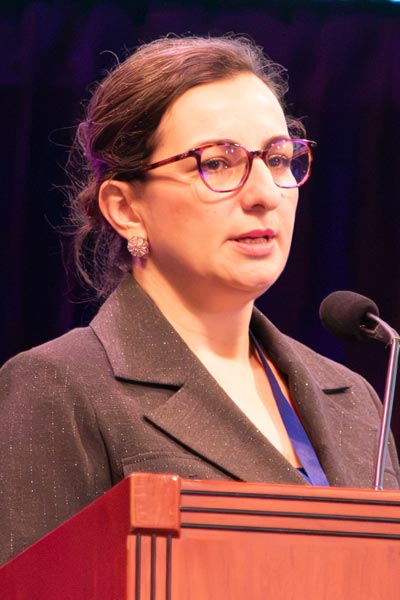
Gokce Kenar-Artin, MD, Associate Professor of Rheumatology at Dokuz Eylul University School of Medicine, Turkey, discussed results from a single-center retrospective study that aimed to identify clinical and radiological predictors of progression and systemic treatment decisions in patients with pulmonary sarcoidosis and to assess whether 18F-FDG positron emission tomography (PET)/computed tomography (CT) provides incremental prognostic value beyond standard CT-based evaluation.
“Abdominal involvement was associated with subsequent thoracic CT progression, highlighting the potential prognostic relevance of progressive disease,” Dr. Kenar-Artin said. “So, look beyond the lungs in pulmonary sarcoidosis.”
In the multivariable logistic regression, two factors were significantly associated with systemic treatment, including a modified Medical Research Council (mMRC) dyspnea score of ≥1 and elevated C-reactive protein (CRP) ≥15 mg/L.
FDG-PET/CT provided no incremental prognostic value beyond standard clinical and CT assessment.
Predicting the Outcome of Immune Checkpoint Inhibitor-Induced Inflammatory Arthritis and Arthralgia: Development of Multivariable Models to Predict Disease Persistence

Kate Harnden, PhD, MBChB, MRCP, of the Leeds Institute of Rheumatic and Musculoskeletal Medicine, United Kingdom, discussed research aimed at developing disease prediction models.
The study aimed to identify baseline clinical and imaging features associated with persistent immune checkpoint inhibitor (ICI)-arthralgia/inflammatory arthritis and future requirement for disease-modifying antirheumatic drugs (DMARDs) or failure to taper prednisolone to less than 10 mg per day.
Results demonstrated that the persistence of ICI-IA and ICI-arthralgia was similar, suggesting that ICI-arthralgia patients do not have a lower-risk phenotype.
“There are three baseline factors that were associated with both persistent disease and severe disease. And these factors were having higher CRP, having tenosynovitis on imaging, and having a peripheral inflammatory arthritis whole body MRI pattern,” Dr. Harnden said.
Models were developed to predict persistence. Adding imaging improved prediction, with the clinical model having an area under the receiver operating characteristic curve (AUC) of 0.75 and the clinical and imaging model having an AUC of 0.86.
Equivalent Effectiveness but Decreased Persistence in Patients Switched to Biosimilar Infliximab: Evidence from Real World Data

Eric Roberts, PhD, MPH, Research Specialist in the Division of Rheumatology, Department of Medicine, at the University of California, San Francisco, discussed results from the largest U.S. real-world evaluation of infliximab biosimilar switching.
The objective of the study was to assess whether biosimilar infliximab is as effective as an originator in patients with RA who switch. The study included data from RA patients who newly initiated originator infliximab between 2015 and 2025 and had six months of use in the ACR Rheumatology Informatics System for Effectiveness (RISE) registry.
“Biosimilar infliximab was equally effective for patients who switched, but we did this in a way that meaningfully added to the existing literature,” Dr. Roberts said. “We used a real-world evidence report, and we were able to overcome methodological limitations of previous studies. We had a very large sample size and a comparator arm. We controlled the length of use, and we did this using the tools that clinicians are using to evaluate their patients every single day.”
Validation of New Clinical Thresholds for Low Inflammatory Activity using Modified Disease Activity Scores in Rheumatoid Arthritis

Joshua Baker, MD, MSCE, Professor of Medicine at the University of Pennsylvania and the Corporal Michael J. Crescenz VA, discussed developing a new clinical threshold.
The study aimed to generate treatment targets for modified disease activity scores that could be used in clinical practice or research, specifically a state of RA low inflammatory activity (RALI).
Researchers defined RALI for multiple modified scores and found that more patients achieved RALI than clinical remission in clinical trials and in the real world. They then characterized patients with RALI versus remission in four independent data sources. Results demonstrated similar radiographic and MRI outcomes between RALI and remission.
“When you look at the patients that are in traditional remission but that are not in RALI, what you see is that there’s a high rate of erosions, nodules, interstitial lung disease, and seropositivity,” Dr. Baker explained. “But when you look at those that are in RALI but that are not in traditional remission, you see high rates of spine degeneration, osteoarthritis, mood disorder, and seronegativity.”

THERE’S STILL TIME TO JOIN US
If you haven’t registered for ACR Convergence 2026, you can still register on-site at the Orange County Convention Center in Orlando, Florida, through November 11. All registered participants receive on-demand access to scientific sessions through September 30, 2027.